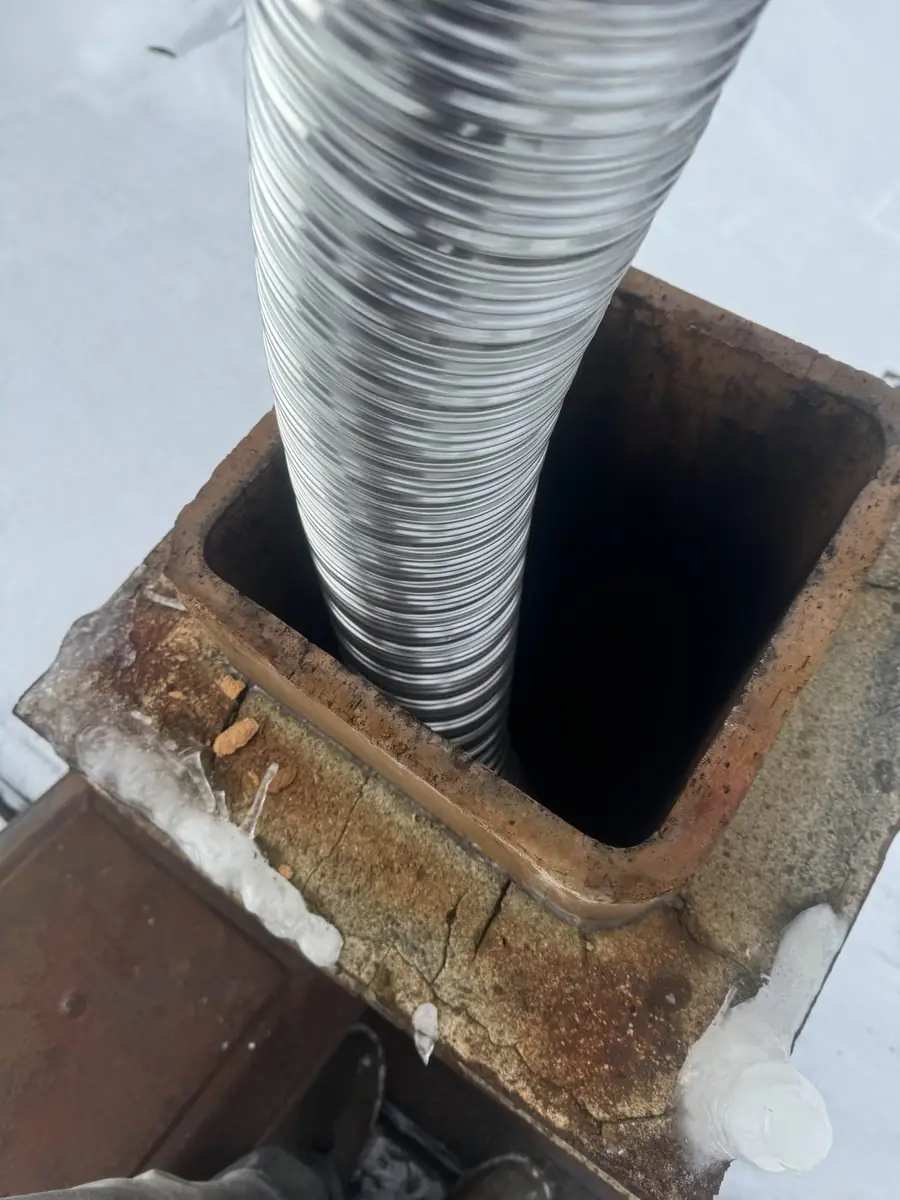
You have never seen your chimney liner. Almost nobody has.
It sits out of sight inside the masonry, and it is the only thing standing between a fire burning at over 1,000 degrees Fahrenheit and the wood framing of your house. A chimney liner does three jobs at once: it contains heat so it cannot reach combustible structure, it carries carbon monoxide and combustion gases out above the roof, and it shields the brick and mortar from acidic byproducts that would otherwise chew through them. Once that liner cracks, flakes, or corrodes through, the fireplace is no longer safe to use, and a chimney liner replacement moves from a maintenance item to the thing you handle before the next fire.
The hard part is that liner failure is almost entirely invisible from your living room. What you get instead are symptoms, and most of them look like something else.
6 Warning Signs Your Chimney Liner Is Failing
Broken Clay Tile Pieces in the Firebox
Terracotta chunks or a fine sandy mortar dust on the hearth is the clearest signal there is. Clay flue tiles do not shed material when they are intact, so debris on the firebox floor means tiles above you are spalling or have already begun to collapse.
Sweep it up and look at what you have. Orange-brown fragments with one smooth face are liner tile. Gray crumbs are mortar from the joints between them. Either way, the material came from a place you cannot see, and it left a gap behind.
Cracks or Gaps in the Flue Tiles
Hairline cracks are not cosmetic in a flue. Clay expands when it heats, which widens every existing crack during each fire and then closes it again on cooling, and that repeated cycling drives a crack deeper through the tile wall with every burn. A gap wide enough to pass flame or gas does not need to be wide enough to see. That is the trap.
This is the failure mode that turns a cracked clay chimney liner into a structure fire, and it is why a camera matters more than a flashlight.
A History of a Chimney Fire
If this chimney has ever had a flue fire, the liner needs to be scoped before you use it again, even if the fire seemed minor and burned itself out in a few minutes. Creosote ignites violently and reaches temperatures that shatter clay tile through thermal shock and warp or buckle stainless steel.
Plenty of homeowners have had one without knowing. A roaring or rumbling sound from the chimney, a sharp hot smell, or dense smoke from the crown are the tells, and our guide to what a chimney fire smells like covers what people actually notice at the time.
Persistent Smoke Odors or Poor Draft
Your fireplace should pull. A hearth that smokes into the room, drafts weakly, or leaves a creosote smell hanging in the house for days is telling you the flue is not moving air the way it was sized to. Breaks in the liner disrupt the pressure column that carries exhaust upward, and a flue that is the wrong diameter for the appliance connected to it does the same thing.
Smoke that comes back at you is not a damper problem until you have ruled out the liner.
Moisture Damage, Rust, or Efflorescence
Go outside and look at the brick. White, chalky staining is efflorescence, mineral salt left behind as water moves through masonry and evaporates, and it means water is getting into the structure rather than being carried out by the flue. Rust on the damper tells you the same story. So does a damp firebox.
Water is the slower killer here. Acidic condensation and rainwater break down clay tile and mortar joints from the inside, and in Northeast Ohio the freeze-thaw cycle does the rest by expanding every trapped drop.
Switching Fuel Types or Appliances
A liner sized correctly for one appliance is frequently wrong for the next. Moving from an open wood-burning hearth to a gas insert, or installing a high-efficiency furnace, changes both the exhaust temperature and the moisture content traveling up the flue.
The mechanism is specific and worth understanding. Cooler, wetter gas exhaust condenses on the flue wall instead of exiting as vapor, and that condensate is acidic. CSIA describes the result plainly: in old chimneys built for oil or wood and later fitted with gas appliances, clay liners can flake apart under corrosive conditions and produce debris that blocks the chimney. Resizing, and usually relining, is part of the appliance change, not an upsell after it.
Why You Should Not Ignore a Damaged Liner
Three consequences, in order of how fast they can hurt you.
House fire risk. Heat escaping through a cracked tile does not need to touch a joist to ignite it. Wood exposed to sustained moderate heat undergoes pyrolysis, a slow chemical breakdown that drives off moisture and volatiles and leaves behind a charred material that ignites at a far lower temperature than sound lumber. A joist beside a leaking flue can be conditioned over several seasons and then ignite on an ordinary evening fire that the same chimney handled for years.
Carbon monoxide exposure. A cracked liner lets an odorless gas pass through mortar joints into bedrooms and living space. The Consumer Product Safety Commission attributes more than 200 deaths a year to carbon monoxide from venting problems, with roughly 10,000 CO-related injuries reported annually, and CSIA notes that low-level exposure is routinely mistaken for a cold, the flu, or ordinary exhaustion. That is the part that makes it dangerous. Nobody investigates fatigue.
Structural masonry decay. Acidic combustion gases that reach the brick work from the inside out, dissolving mortar and spalling brick faces. Left long enough, a job that would have been a reline becomes a partial or full rebuild, and the cost difference between those two outcomes is not small.
Want a certified technician to look at yours? Estimates are free across Northeast Ohio. Request yours here or call (216) 446-2626.
Chimney Relining Options: HeatShield Versus Stainless Steel
Not every damaged liner needs to be torn out. Which repair is right depends on what the camera finds, and we would rather tell you the cheaper answer when the cheaper answer is the correct one.
Option 1: HeatShield Cerfractory Flue Sealant
HeatShield restores an existing clay flue from the inside. It fills cracked tile faces and missing mortar joints with a cerfractory sealant applied against the flue wall, returning the liner to its original safety rating without demolishing masonry or losing flue diameter. Green and Clean is a HeatShield Certified Installer, which matters because the product is applied to a measured thickness and verified by camera afterward.
This is the right call when the tiles are structurally present but cracked or missing mortar. The chimney stays as built. You keep the full flue diameter, and nothing gets torn down.
Option 2: Stainless Steel Chimney Liner Replacement
A stainless steel chimney liner is a new flue installed inside the old one. It is the answer for severely damaged or collapsing clay, for chimneys that were never lined at all, and for resizing when a new appliance needs a different diameter.
Stainless resists the acidic condensate that destroys clay, improves draft because the interior surface is smooth and correctly sized, and carries a lifetime warranty when installed to spec. Insulation is usually part of the job rather than an extra, and our post on whether a chimney liner needs to be insulated explains where it is required and why it affects draft.
| HeatShield Cerfractory Sealant | Stainless Steel Liner | |
|---|---|---|
| Best for | Clay tiles that are cracked or missing mortar but still structurally in place | Severely damaged or collapsed clay, unlined chimneys, resizing for a new appliance |
| Typical lifespan | Restores the flue to its original rated service life | Lifetime warranty when installed to specification |
| Key benefit | Keeps the original masonry and the full flue diameter intact, no demolition | Corrosion resistant, correctly sized, strongest draft improvement |
If you are wondering whether any of this is optional, it is not. Chimney liners are required by code for essentially all modern installations, and an unlined or failed flue is routinely flagged during a property sale.
How We Verify Liner Damage: The Video Camera Inspection
A flashlight from the firebox shows you the first few feet of flue and nothing else. Most liner cracks occur in the middle and upper sections, which are invisible from below and invisible from the crown, and that blind span is exactly where thermal stress concentrates.
So we scope it. A Level 2 chimney inspection runs a high-definition camera the full length of the flue, and you watch the footage of your own chimney rather than taking a technician’s description on faith. Our crews are CSIA Certified Chimney Sweeps, and the inspection produces a written report with camera stills, which is the document a lender, an insurer, or a buyer’s agent will accept.
You should be able to see the crack before you pay to fix it. That is the whole point.
Chimney Relining Across Northeast Ohio
Housing stock is why we do a lot of this work. Cuyahoga, Lake, and Geauga counties hold thousands of brick homes built 50 to 100 years ago, and the original clay liners in those chimneys are now at or past the end of their service life. Neighborhoods like Lakewood, Cleveland Heights, Shaker Heights, and the older sections of Mentor are dense with exactly that profile: sound masonry, original flue, and a liner that has quietly been failing for a decade.
Climate compounds it. Our freeze-thaw cycling drives water into hairline cracks and then expands it, so a crack that would stay stable in a dry climate widens here every winter. Lake-effect moisture keeps the masonry wet longer. More water, more cycles, faster failure.
Green and Clean has served Northeast Ohio since 2016 across more than 15,000 completed jobs, holding a 4.9 star rating from 368 Google reviews and a 5.0 rating from 633 Angi reviews, an A+ BBB accreditation, and both CSIA and HeatShield certifications.
Schedule a Camera Inspection Before Your Next Fire
Do not guess about what is happening inside your chimney, and do not let a $400 inspection turn into a rebuild because a cracked tile went another three winters.
If you recognized two or more of the warning signs above, schedule a CSIA-certified camera inspection and we will show you the footage.
If a liner has already been diagnosed and you need the repair, we handle both HeatShield restoration and stainless steel chimney relining.
Call (216) 446-2626 or email office@greenandcleanhomeservices.com and describe what you are seeing. We will tell you whether it can wait.