Your dryer has been running two cycles to get a load of towels dry. You have probably blamed the machine.
The machine is usually fine. What has changed is the vent behind it, and the dryer vent fire warning signs most Ohio homeowners miss are the boring ones: longer cycles, a warm laundry room, a faint scorched smell on a load of cotton. The U.S. Fire Administration puts failure to clean at the root of 34 percent of residential clothes dryer fires, making it the single leading cause, and those fires peak in fall and winter with January the worst month of the year.
Which means the next ninety days are the window that matters here.
What Are the Warning Signs of a Dryer Vent Fire?
The warning signs of an impending dryer vent fire are longer drying times, excessive heat in the laundry room or on the dryer casing, a burning or musty smell during operation, visible lint at the exterior vent hood, and weak or absent airflow outside while the dryer runs. Any one of them means restricted exhaust. Two or more together means the vent is substantially blocked and the appliance is running hotter than it was designed to run.
Walk through the list below before the heating season gets going.
- Clothes take two cycles to dry. This is the first symptom and the most ignored. A properly vented residential dryer should finish a standard load in 35 to 45 minutes, so when a single load of jeans or towels needs 80 minutes and a second tumble, the moisture has nowhere to exhaust and is condensing back into the drum.
- The laundry room feels hot and humid when the dryer runs. All that heat and water vapor is supposed to leave the building. A room that turns muggy during a cycle tells you the exhaust is backing up into the house instead of making it out the wall.
- The top or side of the dryer is hot to the touch. Cabinet surfaces running too hot to rest your palm on indicate the internal high-limit thermostat is cycling repeatedly, which is a protective device doing a job it was never meant to do continuously.
- You smell something burning, scorched, or musty. Lint ignites at a lower temperature than most people assume. A burnt odor during or right after a cycle is lint cooking somewhere in the duct run or against the heating element, and it warrants shutting the appliance down that day.
- Lint is visible around the outside vent hood. Go look at the exterior termination. Lint collecting on the siding, the louvers, or the ground beneath it means the duct is full enough that it is pushing debris out the only opening left.
- The exterior flapper does not open, or you feel no air. Put your hand at the outside hood mid-cycle. Strong warm airflow is normal. Weak airflow, or louvers that stay shut, means the blockage is severe.
- The dryer shuts off mid-cycle on its own. Modern machines trip a thermal cutoff when exhaust temperature exceeds a safe threshold. A dryer that keeps stopping before the load is done is not failing. It is protecting itself, and it is telling you something.
Notice what these have in common. Not one of them looks like a fire hazard to a homeowner standing in a laundry room, which is exactly why they go unaddressed for two or three seasons.
Why Do Clogged Dryer Vents Catch Fire?
A clogged dryer vent catches fire because restricted airflow traps heat in the duct, and the lint packed inside that duct is a dry, finely divided fuel sitting directly in the path of 130 to 160 degree exhaust air. Remove the airflow and the system loses the mechanism that was carrying that heat out of the building.
Lint is cellulose fiber with enormous surface area relative to its mass. That is the whole problem in one sentence. The same property that lets it float out of your clothes makes it ignite readily and spread flame fast once it does.
Then there is the compounding part most people never see. As a duct narrows, the dryer’s blower works against increasing static pressure, exhaust velocity drops below the roughly 1,200 feet per minute needed to keep lint entrained in the airstream, and particles that would have been carried outside instead settle onto the duct wall, which narrows the duct further and accelerates the whole cycle. Our breakdown of how hot a dryer vent actually gets covers the temperature side of this in more detail.
Gas dryers add a second hazard. A blocked exhaust on a gas appliance can push combustion byproducts, carbon monoxide among them, back into the laundry room rather than out the termination.
Why Northeast Ohio Homes Clog Faster Than Average
Three regional conditions shorten the interval between cleanings here, and they have nothing to do with how you do laundry.
Housing stock is the first. Much of Lake, Cuyahoga, and Geauga county inventory predates 1980, and dryers in those homes were frequently added to basements or interior laundry closets well after the house was built. That means long duct runs with multiple elbows, and every 90 degree elbow adds the equivalent of roughly five feet of straight run to the effective length. A nominal 25 foot duct with four turns behaves like a 45 foot duct, which is past what most residential blowers were sized to handle.
Roof terminations are the second. Plenty of Northeast Ohio homes vent the dryer vertically through the roof because there was no practical sidewall route, and vertical runs fight gravity the entire way while giving lint a cold upper section to condense and stick to. If yours exits at the roof, what to know about roof-vented dryers is worth reading before winter.
Our climate is the third. Lake-effect humidity through the fall loads the exhaust stream with moisture, and damp lint behaves nothing like dry lint: it packs down, adheres to duct walls, and resists the airflow that would otherwise clear it. Cold outside air at the termination makes the condensation worse. This is why we see call volume on blocked vents climb every October and stay up through February, which tracks the national pattern the U.S. Fire Administration documented in its residential clothes dryer fire report, where January alone accounts for 11 percent of the annual total.
Want a certified technician to look at yours? Estimates are free across Northeast Ohio. Request yours here or call (216) 446-2626.
What Should You Do If You Notice These Signs?
Stop using the dryer until the vent has been cleared, then determine whether the blockage is in the lint trap, the transition hose, or the duct run itself. Those three locations require three different fixes, and only one of them is a homeowner job.
Pull the lint screen and clean it, then hold it under running water. Water that pools on the mesh rather than passing through means dryer sheet residue has sealed the screen, and a soft brush with warm soapy water will restore it. That takes four minutes and occasionally solves the whole problem.
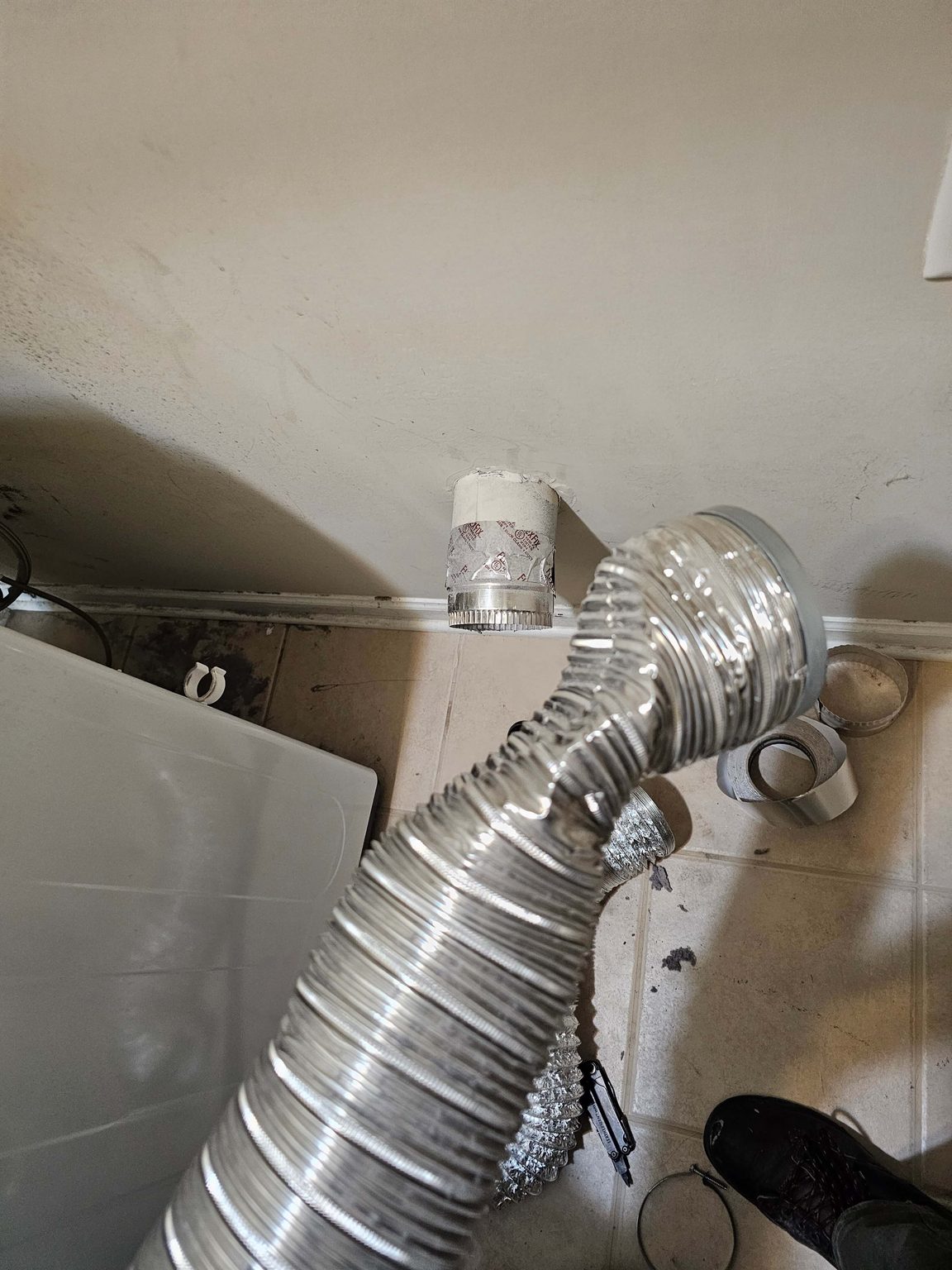
Next, pull the dryer out and check the transition hose, the flexible section between the appliance and the wall. Crushed foil or vinyl flex behind a dryer that was pushed back too far is one of the most common restrictions we find, and if yours is white vinyl, replace it. Vinyl flex duct is no longer code compliant for dryer exhaust in most jurisdictions because it burns.
If the screen is clean and the transition hose is clear and intact, the blockage is inside the wall or ceiling duct, and that is where DIY stops being useful. Consumer-grade brush kits typically reach 12 to 20 feet and cannot negotiate multiple elbows, which means they often compact the clog deeper rather than extracting it.
Professional cleaning uses a rotary brush driven the full length of the run with negative-pressure capture at the appliance end, and the duct is camera-verified afterward so you know it is actually clear rather than merely improved. We also perform an airflow reading before and after, because a number is the only honest proof the job worked.
Call us immediately, without troubleshooting first, if you smell burning during a cycle, if the dryer cabinet is too hot to touch, or if the machine has started shutting itself off mid-load. Those are not maintenance symptoms.
How Often Should an Ohio Dryer Vent Be Cleaned?
Once a year for an average household, and every six months for homes with four or more people, pet owners who wash bedding frequently, or any home with a duct run over 25 feet or a roof termination. Households running more than five loads a week should plan on the shorter interval regardless of duct configuration.
Annual cleaning is the baseline, not the ceiling. Our full guide to how often clothes dryer vents should be cleaned breaks the schedule down by household size and duct type.
One more note on timing. Book before the first hard freeze if you can, because once the cold sets in, laundry volume climbs, drying times stretch, and the vent is under more load during precisely the months when the fire statistics are worst.
Schedule a Dryer Vent Inspection Before Winter
Green and Clean Home Services has cleaned and repaired dryer vents across Lake, Cuyahoga, Geauga, Summit, Portage, Medina, and Lorain counties since 2016, with CSIA Certified Dryer Exhaust Technicians on staff. Every job includes camera verification of the full duct run and a before and after airflow reading, so you leave with proof rather than a promise.
If you recognized two or more of the dryer vent fire warning signs above, schedule a dryer vent cleaning before the heating season peaks.
If your duct is crushed, disconnected, improperly routed, or still running white vinyl flex, we handle dryer vent repair and replacement as well.
Not sure whether what you are seeing is serious? Call (216) 446-2626 and describe it. We will tell you whether it can wait until spring, and sometimes the answer is yes.